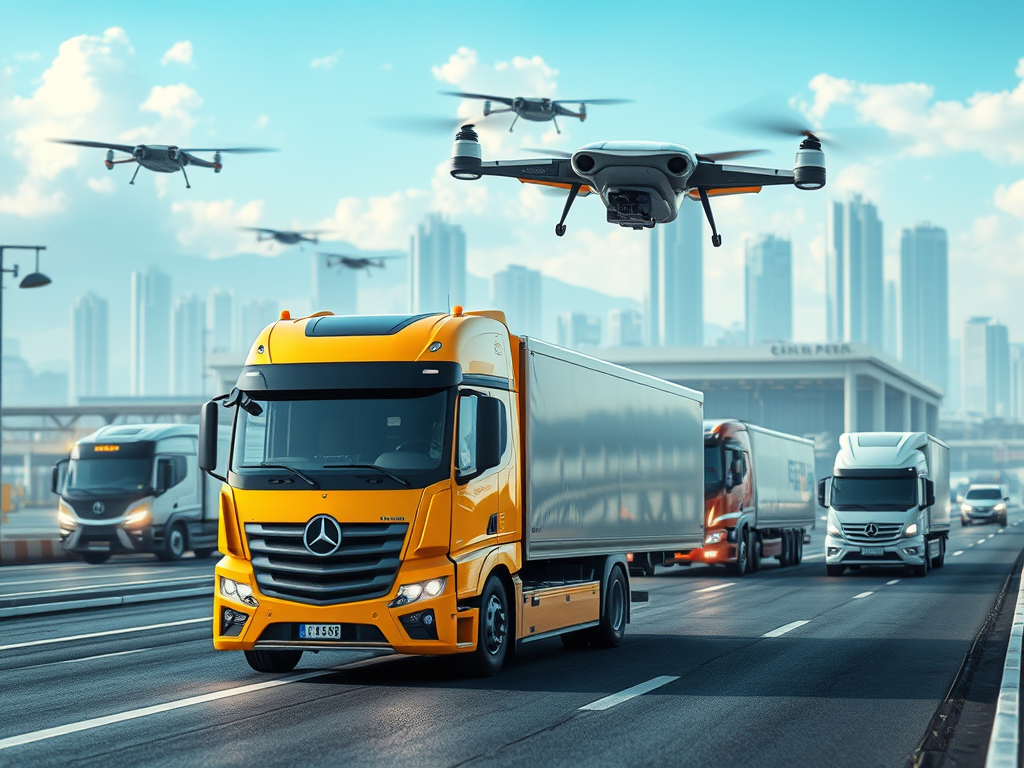
Technology is fundamentally reshaping transportation and logistics, with a new generation of innovations centered on AI, autonomous vehicles, and satellite technology. These advancements are moving the industry from reactive to predictive, making supply chains smarter, more resilient, and more efficient.
AI: The Brains of the Operation
Artificial intelligence is becoming the backbone of modern logistics, moving beyond simple task automation to power complex decision-making.
- Next-Gen Route Optimization: AI-powered GPS systems are a major game-changer. Unlike traditional GPS that relies on static data, these new systems analyze real-time conditions like traffic congestion, weather changes, and road closures to dynamically reroute vehicles. This leads to major reductions in fuel consumption, travel time, and delivery disruptions.
- Predictive Analytics: AI models are now so advanced they can act as a “crystal ball” for the supply chain. They analyze vast datasets to accurately predict demand, allowing companies to optimize inventory, proactively manage capacity, and even predict potential over- or underbooking of freight days or weeks in advance.
- Agentic AI: This is a major area of development. Agentic AI systems can perform multi-step, complex tasks with greater autonomy, freeing up human operators from manual, repetitive work. This partnership between humans and AI allows for a new level of agility and strategic thinking.
Autonomous Vehicles: Driving Efficiency and Safety
Autonomous vehicles are no longer a future concept; they are being deployed to address some of the industry’s biggest challenges, like the long-haul driver shortage.
- Long-Haul Trucking: Fully autonomous trucks are on the verge of commercialization, with companies testing and deploying self-driving big rigs on highways. These vehicles can operate continuously, 24/7, without rest stops, significantly cutting down transit times.
- Last-Mile Delivery: In urban environments, autonomous delivery robots and drones are helping to solve the costly “last-mile problem.” These small, driverless units can handle local deliveries, providing contactless, around-the-clock service.
- Platooning and Safety: Autonomous vehicles can communicate with each other to form “platoons.” By traveling in close proximity, they reduce aerodynamic drag, which leads to better fuel efficiency. They also have the potential to significantly improve road safety by eliminating human error.
Satellite Tech: Global Visibility and Connectivity
Satellite technology is providing an unprecedented level of real-time visibility and connectivity across the global supply chain, especially in remote areas where terrestrial networks are unreliable.
- Real-Time Tracking & Monitoring: Satellite IoT (Internet of Things) devices provide continuous, real-time data on the location and condition of shipments—including temperature and humidity—anywhere on Earth. This is crucial for high-value or temperature-sensitive goods.
- Digital Twins: Data from satellites and sensors is being used to create “digital twins”—virtual replicas of supply chains. This allows companies to run simulations and predict how their network would be affected by a disruption, such as a severe weather event or a port closure.
- Independent Networks: New constellations of Low Earth Orbit (LEO) satellites, like SpaceX’s Starlink, are providing high-speed, low-latency connectivity, enabling real-time communication for autonomous vehicles and data transmission from remote assets. This new technology is making global operations more secure and efficient than ever before.

Leave a comment