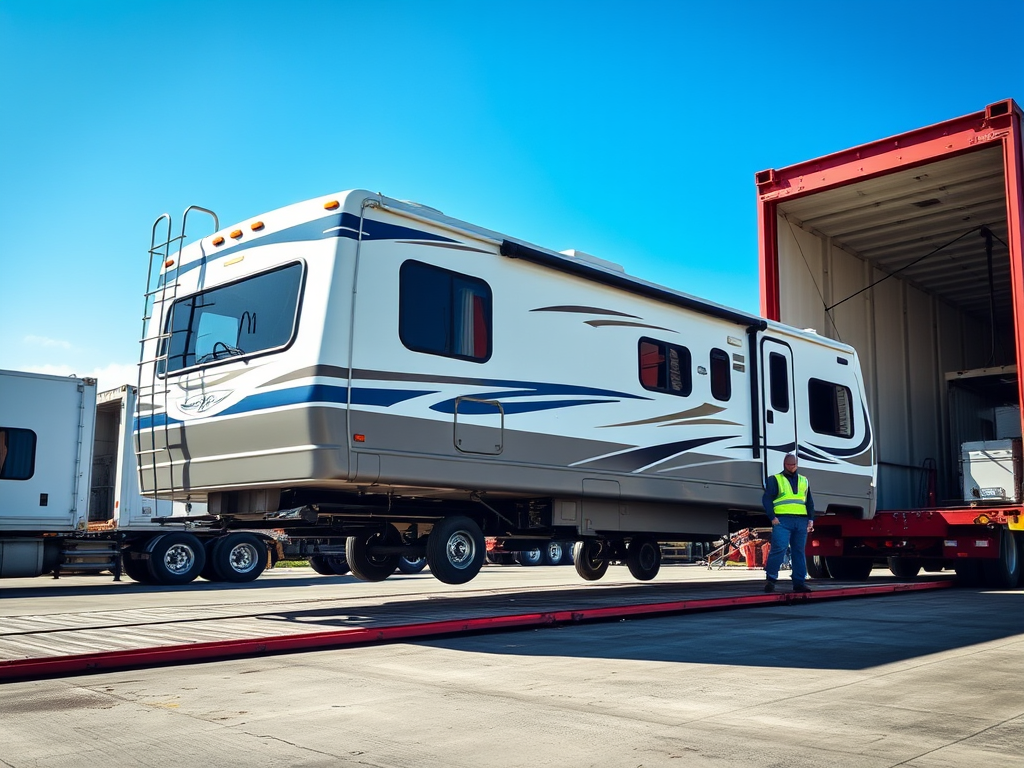
When it comes to vehicle transport, most people picture a fleet of standard cars heading down the interstate. But what happens when your vehicle is a massive RV, a construction bulldozer, a vintage bus, or a car that simply can’t roll?
This is where AAS LLC USA steps in. Specializing in the logistics of the non-standard, we are experts in transporting oversized vehicles, regardless of their condition or the type of trailer you need.
What Makes a Vehicle “Oversized”?
An oversized vehicle is any unit that exceeds the standard legal limits for width, height, length, or weight, often requiring special permits from state to state. This category includes a vast range of machinery and large vehicles, such as:
- Large Motorhomes and Class A RVs
- Heavy Equipment (e.g., excavators, bulldozers, tractors)
- Modified or Custom Vehicles (e.g., elongated limousines, lifted trucks)
- Commercial vehicles like Buses and Food Trucks
- Boats and large trailers
Transporting these giants is a complex operation that demands specialized trailers, meticulous route planning, and full regulatory compliance—all of which are handled end-to-end by the AAS LLC USA team.
Your Transport Options: Open vs. Enclosed
Choosing the right transport method is crucial for an oversized load. We offer both secure options:
1. Open Carrier Transport (The Efficient Choice)
Open carriers are the most common and cost-effective way to move large vehicles.
- Best for: Standard RVs, buses, and commercial trucks that are rugged and regularly exposed to the elements.
- The Equipment: Oversized open transport utilizes specialized trailers like Flatbeds, Lowboys, and Step-Deck trailers that can accommodate extra height or width.
- The Advantage: It is the most economical solution and has a greater availability of carriers, often leading to faster pickup times.
2. Enclosed Carrier Transport (The Premium Choice)
For high-value, luxury, or historic oversized vehicles, enclosed transport offers maximum protection.
- Best for: Custom-painted RVs, rare vintage buses, or new commercial vehicles where avoiding any exposure to road debris or weather is a top priority.
- The Advantage: The vehicle is fully shielded inside a protected trailer, offering peace of mind for clients shipping their most valuable assets.
Operable vs. Non-Operable: Specialized Handling for Every Condition
The condition of your vehicle changes the entire loading process, especially for oversized equipment. AAS LLC USA is equipped to handle the full spectrum:
| Vehicle Condition | Loading Method & Requirements |
| Operable | The vehicle can be driven onto the specialized trailer under its own power. The main requirements are careful maneuvering and precise positioning to ensure even weight distribution. |
| Non-Operable (Winch-Ready) | The vehicle cannot start but can still roll, steer, and brake. A powerful winch is used to slowly and safely pull the vehicle up the loading ramp and onto the trailer deck. |
| Non-Operable (Forklift-Only) | The vehicle is immobile—it cannot roll or steer (e.g., a salvaged shell, missing wheels, or seized axles). This requires coordinating a heavy-duty forklift or crane at both the pickup and delivery points to lift the vehicle onto and off the flatbed trailer. |
Export to Sheets
The AAS LLC USA Difference: Permitting and Compliance
Transporting anything oversized requires more than just a big truck; it requires navigating a labyrinth of regulations. Every state has different rules on maximum height, width, and weight, as well as specific travel curfews and escort requirements.
Our service includes:
- Route Engineering: Planning a safe route that accounts for bridge clearances, construction zones, and sharp turns that would be impossible for an oversized load.
- Permit Acquisition: Securing the necessary oversize and overweight permits for every state and jurisdiction along the route.
- Safety Logistics: Arranging for Pilot/Escort Cars (required for certain dimensions) and ensuring the load has all necessary warning flags and signage.
Don’t let the size or condition of your vehicle become a logistical nightmare.
Whether you have a fully operational tour bus or a non-rolling piece of custom equipment, AAS LLC USA provides the specialized carriers, expertise, and personalized service to ensure a safe, compliant, and on-time delivery.
Ready to move your oversized vehicle? Contact AAS LLC USA today for a comprehensive, no-obligation quote and let us handle the heavy lifting.
How do I get a quote for shipping a non-running RV?
Google Search
- Query successful
Try again without apps
Getting a quote for shipping a non-running RV requires careful communication with the transport company because it falls under the “oversized and non-operable” category, which adds complexity and cost.
Here is a step-by-step guide on how to get the most accurate quote, especially from a company like AAS LLC USA that specializes in complex, oversized transport:
1. Gather All Necessary Information
The cost of shipping a non-running RV is heavily dependent on its exact specifications and condition. You must be prepared to provide the following details:
| Information Needed | Why It’s Critical for the Quote |
| Pick-up and Delivery Locations | Full address, including city, state, and ZIP codes. This determines the route distance and required state permits. |
| RV Make, Model, and Year | E.g., 2005 Thor Motor Coach Four Winds 31A. This helps identify the base size and weight. |
| Exact Dimensions and Weight | Crucial for Oversized Loads. You need the exact Length, Width, Height, and Gross Vehicle Weight (GVW). Even a few inches can change the trailer requirements and permit fees. |
| Non-Running Condition Details | This is the most important factor for an accurate quote: |
| A. Does it roll, steer, and brake? (Can it be pushed and guided?) | |
| B. Does it require a winch? (It needs to be pulled onto the trailer.) | |
| C. Is it completely immobile? (Does it require a forklift or crane to load/unload?) | |
| Access at Locations | Can a large semi-truck and trailer easily access the pick-up and drop-off points? (Is it a wide, commercial yard or a tight residential street?) |
| Desired Carrier Type | Open (standard) or Enclosed (premium protection)? |
| Availability Date | When the RV will be ready for pickup. |
2. Contact AAS LLC USA Directly
Since you are shipping an oversized, non-running vehicle, it is best to call the company rather than relying solely on an automated online quote calculator, as the specialized details often require human review.
- Online Quote Form: Many companies have a dedicated section on their website for “oversized” or “non-running” vehicle quotes. Use this to submit your initial data.
- Phone Call: Call the main number (855) 313-3171 and specifically state, “I need a transport quote for a non-running, oversized RV.”
3. Be Transparent About the Condition
The non-running status is a significant cost factor because it requires specialized equipment (winches, lowboy trailers) and more labor/time for the driver.
- Do not downplay the condition. If the RV is missing a wheel or the steering is locked, disclose this upfront. Failing to do so can result in the driver being unable to load the RV, leading to costly delays or canceled trips.
- The company will need to ensure they dispatch a carrier that is properly equipped to handle the specific loading challenge of your immobile RV.
What Determines the Final Cost?
- Specialized Equipment Fee: A surcharge will be added for the winch-out or forklift requirement.
- Oversize Permits: The company will charge a fee for obtaining all necessary state and local permits.
- Distance and Route: Longer distances and routes through states with stricter permit laws increase the cost.
- RV Class: Class A motorhomes will cost significantly more than a smaller travel trailer due to size, weight, and complexity.

Leave a comment