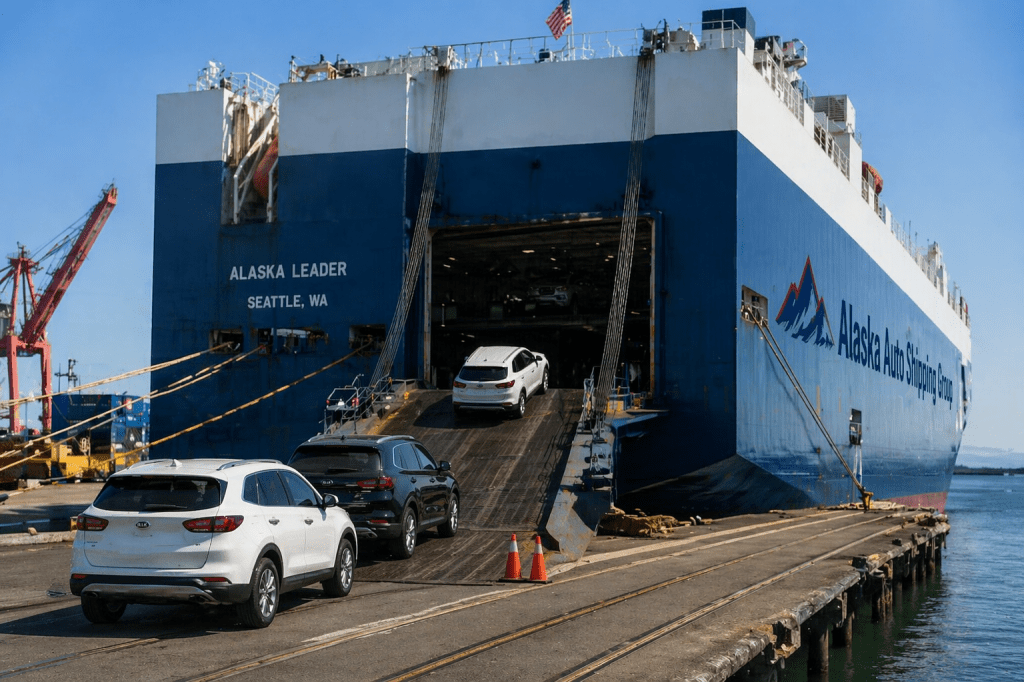
The marine barge industry provides a specialized logistical backbone for moving high volumes of vehicles—ranging from standard sedans to heavy construction equipment—across major waterways. When standard over-the-road trucking isn’t feasible or cost-effective, barging offers a high-capacity, fuel-efficient alternative.
The Strategic Role of Barge Transport
Barge shipping is primarily utilized for coastal transit and river-system logistics. Unlike deep-sea Ro-Ro (Roll-on/Roll-off) vessels, barges can access shallower ports and inland waterways, making them essential for reaching island territories or remote coastal hubs.
1. High-Volume Efficiency
A single standard barge can carry dozens to hundreds of vehicles simultaneously. This consolidation significantly reduces the cost-per-unit compared to a fleet of car carriers. For dealerships or rental agencies moving inventory between regional hubs, this “mass transit” for cars is often the most economical choice.
2. Specialized Equipment Handling
Barge decks are uniquely suited for Oversized and Overweight (OSOW) loads.
- Heavy Machinery: Excavators, cranes, and agricultural equipment that exceed highway weight limits can be rolled onto a barge without the need for complex dismantling.
- Non-Running Units: Because barges use ramps similar to Ro-Ro ships, inoperable vehicles can be winched aboard more easily than onto a standard multi-car trailer.
3. Sustainability and Safety
Marine transport is remarkably fuel-efficient. On a ton-mile basis, a barge can move cargo significantly further on a single gallon of fuel than a truck. Furthermore, moving vehicles via water bypasses highway congestion, reducing the risk of transit-related “road rash” or accidents common in long-haul trucking.
| Feature | Marine Barge | Open-Air Car Carrier |
| Capacity | High (50–200+ units) | Low (7–10 units) |
| Best For | Coastal/Inland Waterways | Door-to-Door Domestic |
| Speed | Slower (Tug-dependent) | Faster (Highway speeds) |
| Cost | Lower per unit | Higher per unit |
| Handling | Minimal (Ro-Ro style) | Frequent (Loading/Unloading) |
When to Recommend Barge Services
Barge services are a logistical “secret weapon” for specific scenarios:
- Island Logistics: Moving fleets to Hawaii, Puerto Rico, or the Alaska often begins with a barge transit from a coastal hub.
- Intermodal Links: Using barges to bridge the gap between a railhead and a final coastal destination.
- Seasonal Relocation: Large-scale rental car “deflation” or “inflation” cycles where hundreds of units must move between regions at once.

Leave a comment